
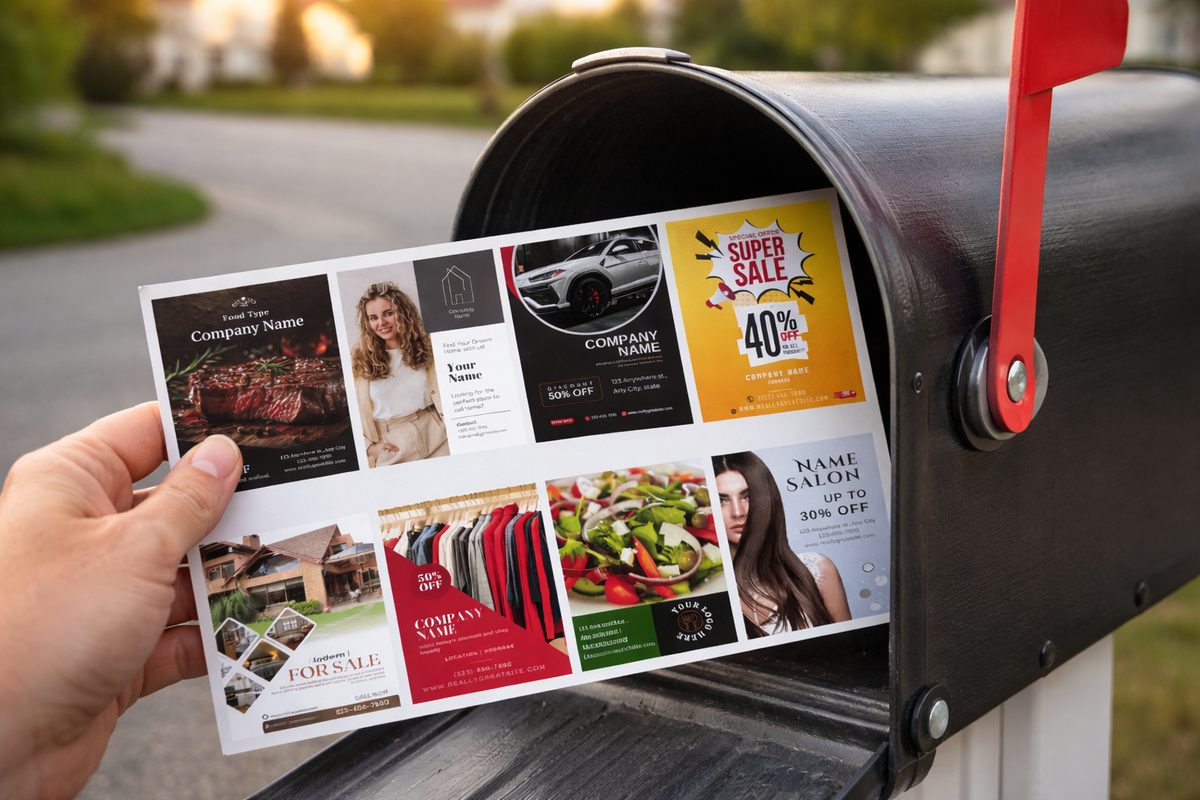
Most direct mail fails for a reason that has nothing to do with the design. It fails because of when it arrives.
A postcard from a plumber lands on a Tuesday in a house with no plumbing problem. It gets a two-second look and goes in the recycling. The work was fine. The timing was impossible. No business can mail often enough to be holding the card on the day the water heater goes.
The refrigerator is the real target
Watch what a household actually keeps. Not the coupons. Not the flyers. What survives is the one piece of paper that answers a question the family knows it will eventually have — the pediatrician’s after-hours number, the number for the people who did the driveway.
That paper gets a magnet and a spot at eye level, and it stays there for a year.
A single-business card asks to be remembered. A card with ten trades on it asks to be kept. Only one of those is a decision a household will actually make.
The difference is not persuasion. It’s utility. A card carrying the plumber, the electrician, the dentist, the vet, the HVAC company and the lawn crew is a small local directory, and a local directory is worth keeping even on a day when nothing is broken.
What that changes about cost
Being on the refrigerator for a year is worth far more than being seen once. It also costs each business far less, because the printing and postage for a 9×12 card are split rather than carried alone.
- One business pays for a card that gets thrown away.
- Ten businesses split a card that gets kept.
- Each one is seen every time anyone in that house looks for a number.
That’s the arithmetic, and it is the entire reason shared mail works where solo mail usually doesn’t.
One business per category
A card with two plumbers on it is worth less to both of them, and it tells the household that the card is advertising rather than a resource. So each category is held by one business for the life of the card.
This is also why availability matters more than budget. If a plumber in your service area has already taken the spot, the answer isn’t a discount — it’s a different neighborhood or a different mailer.
Questions people ask
How is shared direct mail different from the coupon packs we already get?
Coupon packs are loose inserts from national advertisers, and they are sorted straight into the trash as a unit. A single 9×12 card carrying local businesses is one piece, it cannot be separated, and the trades on it are ones the household recognizes as local.
How long does one card keep working?
Far longer than the week it arrives. Because the card is kept rather than read and discarded, calls come in steadily for months — often from a mailing a business had nearly forgotten about.
What areas do you mail into?
Targeted neighborhoods across Richmond, Rosenberg, Sugar Land, Katy, Fulshear and the rest of Fort Bend County. Each mailer is built around a set of neighborhoods rather than a zip code, so the businesses on it are genuinely local to the people receiving it.
Does the mailer include anything online?
Yes. Every business on a card is also featured on the neighborhood websites for the areas the card goes to — the front-page business spotlight, the neighborhood electronic newsletter, and a written feature article. That is included, not an add-on.