
Most churches don’t have a technology problem. They have a scattering problem.
The website works. The membership software works. The Facebook page gets posts. The bulletin gets printed every Sunday and the group texts keep going all week. Nothing is broken, exactly. And yet the actual life of the congregation is spread across six or seven places, and nobody — not the pastor, not the staff, not the members — can see all of it at once.
That scattering has a cost, and the cost isn’t inefficiency. It’s the meal train half the congregation never heard about. It’s the family in the third row who stopped coming, and nobody noticed for six weeks. It’s the man who repairs air conditioning for a living sitting four pews from the widow whose unit died in July. Both of them were in the building. Neither of them knew.
None of that is a failure of care. It is a failure of visibility. Care cannot reach what it cannot see.
So we built one place where it can be seen. It sits under your church’s name, in your church’s colors, and it has two halves.
The first half is open to anyone. Service times, the calendar, this week’s sermon, the ministries you run, the staff, what’s happening around town. It answers the question a visitor is actually asking, which is not “what do you believe” but “should I come, and will I know what to do when I get there.”
The second half is for members. The prayer wall. Meal trains. A directory. Neighbors with skills. Things people are giving away. This is where a congregation stops being an audience and starts being a body — where somebody in the hospital gets fed, and somebody with a truck helps somebody move.
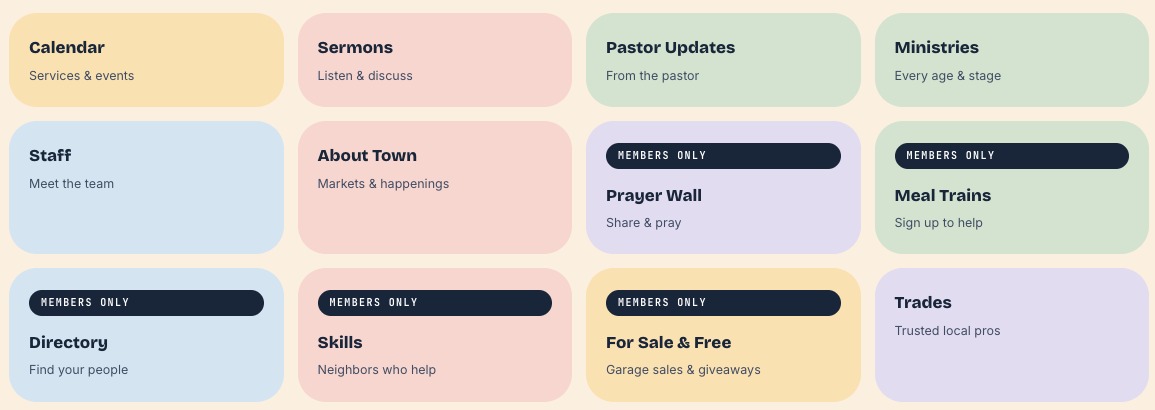
A word about what’s locked, because it would be easy to read it wrong. The private sections are not a velvet rope. Nobody wants their hardest week posted where the whole internet can read it, and a family in crisis deserves the same discretion they’d get in a hospital room. That is all the lock is for. You don’t put a door on the kitchen to keep people out of the house — you have a kitchen so you can feed them.
Because that is the actual purpose of the members’ half. A congregation that knows each other — who’s sick this week, who owns a truck, who fixes air conditioners — is a congregation that can show up for somebody outside it on short notice. Knowing each other isn’t the destination. It’s how a church gets strong enough to be useful to its town.
So the other half points outward, and it is open to anyone. A garage sale the whole street is invited to. A host week for families without housing, run alongside other congregations who don’t share your letterhead and don’t need to. A men’s group moving furniture for an elderly neighbor who has never set foot in the building. None of it asks anyone to join anything first. That is how a church becomes known by the community it serves, rather than merely located in it.
One section is worth explaining, because a board will ask about it. Trades is a public list of local people your members actually trust — the plumber, the electrician, the lady who does taxes. Any member of your church can add their own business to it for free, because they belong to the congregation, and that is the whole point of the list. We also place businesses from our neighborhood mailer there. Those are labeled Sponsored, every single time, without exception. Your members are never the paid listings, a visitor can always tell which is which, and if your church would rather have no sponsored listings at all, that switch belongs to you.
Now the part most pastors are bracing for, so let’s say it plainly: we are not replacing anything. Keep your website. Keep your membership software. Keep the Facebook page and the bulletin. The Hub doesn’t compete with any of them — it gathers what they were never built to hold, and it connects what you already have instead of asking you to start over.
The second concern is usually workload, and it’s a fair one. Every good idea eventually lands on whoever runs the office. So members submit their own events and posts, and nothing goes live until someone on your staff approves it. You get a congregation full of contributors without handing anyone the microphone.
And you don’t build it. We do. You give us what you already have — service times, ministries, staff, your calendar — and we hand you back a working hub in a matter of days, not a project that eats somebody’s spring.
A church that only talks to itself turns into a club. A church that only faces outward wears its own people down. The Hub is built so a congregation can do both — know each other well enough to actually help, and then go be human alongside their neighbors.
A church has never been a building, and it has certainly never been a database. It’s people who show up for each other, and then for everybody else, week after week, mostly without being asked. That has been true a lot longer than the internet has existed. It just deserves somewhere to happen.